Take the card photo in a minute you can still manage the dog: one cue the dog already knows, the tree or the lights behind the dog, and you between the dog and anything the dog wants to grab. A store's Santa setup is a different product with the store's own rules. The at-home card is a training problem that happens to need a camera.
In this guide
The useful pictures are short. A dog that will sit or down on a mat for a few seconds can give you a frame. A dog that has never held a stay will not invent one because you hung a wreath. Practice the stay on a Tuesday with the lights off. Decorate, then shoot, then close the room. Keeping the dog out of the tree is the rest of December. The photo is one watched minute inside that plan.
What setup produces a card without a fight?
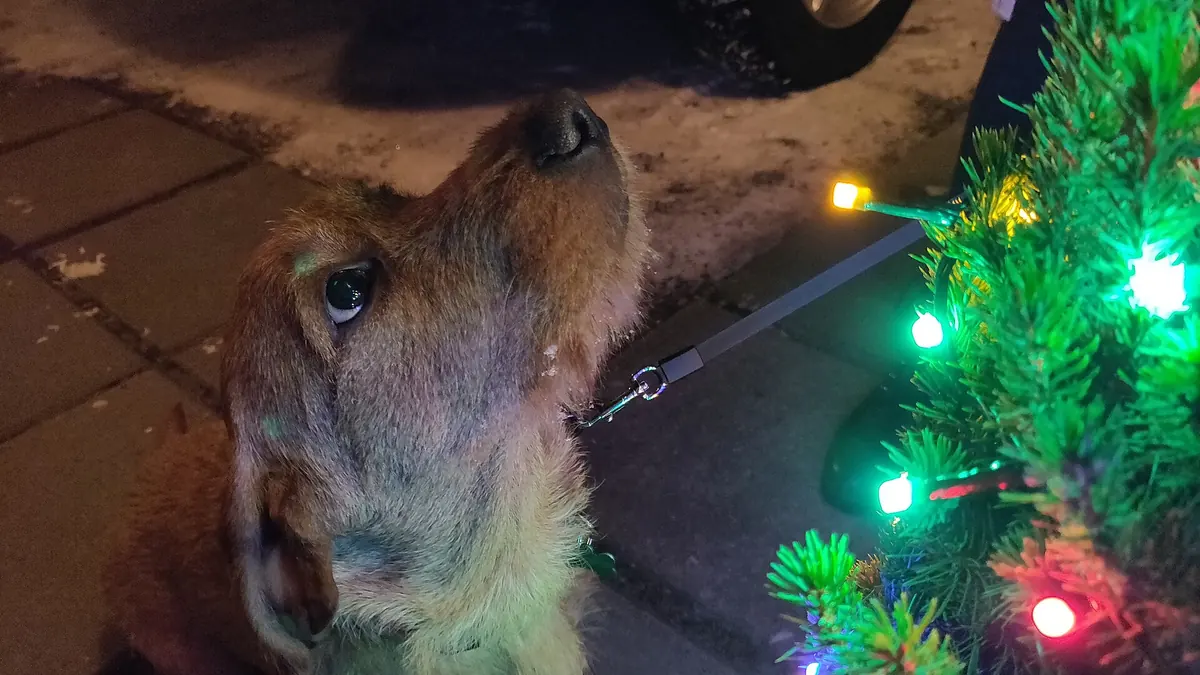
Put the mat where the dog already works, several feet from the lowest branches and from the tree water. Ask for the sit or the down. Pay it. Shoot while the dog is paid and looking at you or at a helper, not while you lean over the dog's head with a phone. If the dog startles at a direct flash, stop using the flash. That is a practical abort, not a photography diploma. Continuous room light, including the tree lights, is enough for a card that is supposed to look like your house.
Shoot at the dog's eye height. A photo from your standing eye line turns the dog into a forehead and a floor. Kneel, or set the phone on a stack of books. Take several frames and stop when the stay gets worse, not when you have "enough content." The ASPCA's description of a dog that goes still, licks its lips, yawns, or looks away is a reason to end a session, including a cute one. Those signals are on the bite-prevention page as stress and conflict, not as a portrait style. The same signals end a park visit. They can end a living-room shoot.
What belongs in the frame, and what should stay out?
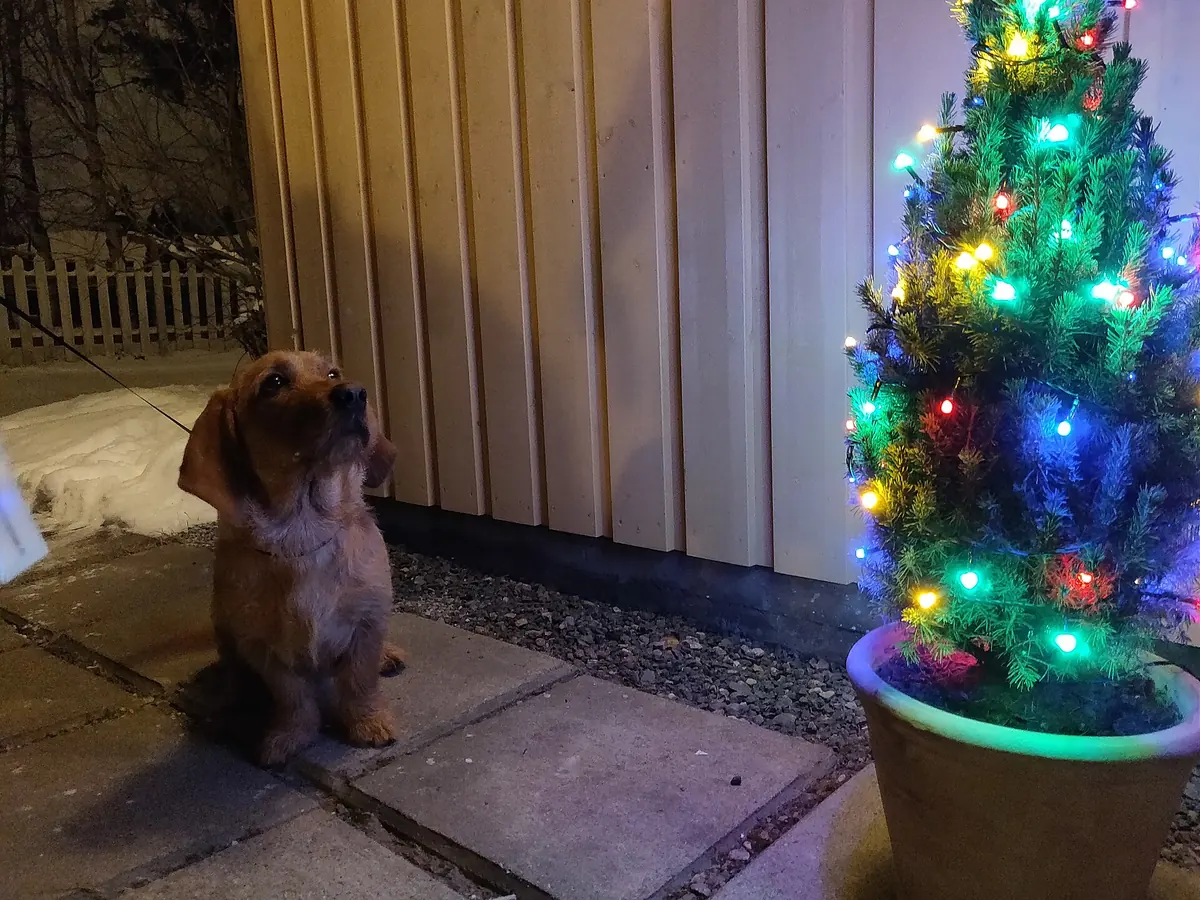
Lights in the background, a plain sweater if the dog already wears clothes without freezing up, and a face you can see. Tinsel at mouth level, a popcorn garland, a glass ornament in the foreground, and a toddler holding the dog's face are how a card shoot becomes the tree article's failure mode. Guests do not feed the dog from the branches for the picture. You will live with that habit after the card is mailed.
| In the frame | Out of reach |
|---|---|
| A mat, a sit or a down, eye-level camera | Edible garlands and hanging food |
| Tree lights as background | Direct flash if the dog already flinched |
| One person the dog knows, paying the cue | A crowd calling the dog from three sides |
| A sweater the dog has worn before, if you want one | A brand-new costume five minutes before the shutter |
Store photo nights are not this setup. Santa Paws events publish their own arrival rules, fees, and whether a reactive dog should skip the line. Read that page, or the store's current one, before you promise a child a lap photo. An at-home card does not need a stranger in a suit. If you want the suit, you need the store's rules, not this paragraph.
Whose photo is legal to print on a card?
Yours, or one you have a license to print. The dog pictures in this article are Wikimedia Commons files with the credits in the captions. Those licenses let Pawnauta show them here with attribution. They are not a pack of free Christmas cards for a stranger's dog, and they are not your dog. A shelter's Instagram photo has a copyright holder, often the photographer or the shelter. Reposting it onto a printed card for your office is a different use from a social share, and many of those posts never granted that use. Shoot your household. If a shelter invites photographers, the invite will say what you may publish. National Mutt Day is not a release form.
- Practice sit or down before the decorations are interesting.
- Mat placed away from the trunk, the water, and the lowest ornaments.
- Camera at the dog's eyes. A few frames. Stop when the body tightens or the dog looks away and licks its lips.
- No edible ornaments in the shot, and no guest feeding the tree.
- Flash off if the dog startles.
- Print a photo you took, or a photo you have rights to print.
- When the camera is down, the unsupervised rule returns: the dog is out of the open tree room.
If the dog is already grabbing branches, you are done shooting. Close the room. A sharper photo of a bad habit is still a bad habit, and you will see it every time the card comes back from a relative. Call a veterinarian if something was swallowed. Do not finish the burst.
What if you want the dog in a sweater for the card?
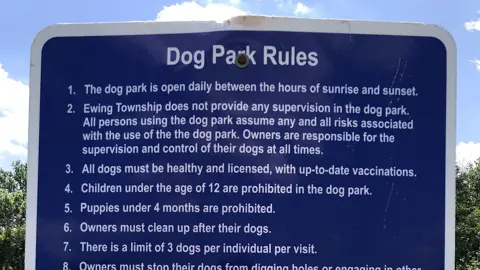
Use a sweater the dog has walked in, on a normal day, without pawing at it. A first wearing during a photo is how the picture becomes a blur of scratching. A contest is a public event with park rules. A card is your living room. Puppies show up in a lot of sweater photos. Many dog parks bar young puppies. A card at home does not require a park, and a park contest does not become legal because the puppy photographed well. Keep those decisions apart.
Two dogs in one frame need two cues or a dog who will settle while the other works. If you do not have that, shoot them one at a time and accept a collage. Forcing a greeting for the card is the same mistake as forcing a greeting on a sidewalk. Leashed greetings are optional. A Christmas card is also optional. The dog's ability to hold a down is the constraint.
Frequently asked questions
How do I get a Christmas card photo of my dog at home?
Practice a sit or a down first. Put a mat away from the tree, shoot a few frames at the dog's eye height while someone pays the cue, and stop when the dog shows stress or starts grabbing. Then close the room.
Should I use a flash?
If the dog startles, stop. Tree lights and room lights are enough for a card that is supposed to look like your house.
Can I use a dog photo from the internet?
Only if the license or the owner allows that use. The Commons photos on this page are credited for the article. They are not your card. Shoot your dog.
What about a store Santa photo?
Follow that store's current event page. Pawnauta's Santa Paws guide covers how those nights are structured. An at-home card does not need them.
The dog will not sit. Now what?
Mail a card without the dog, or shoot a walk you already take, from eye height, on a day the dog is loose and calm. Do not build the shot on a struggle with the tree.
Sources: ASPCA, Dog Bite Prevention, stress and conflict signals (lip licking, yawning, looking away, stillness) used here as a reason to end a photo session; Pawnauta's guide to keeping a dog out of the Christmas tree for the room rule; store photo events are covered in the Santa Paws guide and on each retailer's current page. Commons images in this article stay under their licenses and are not a card template. No camera-gear test was run for this piece.