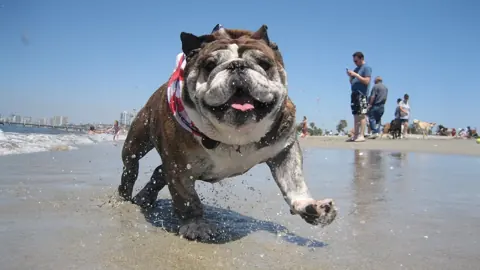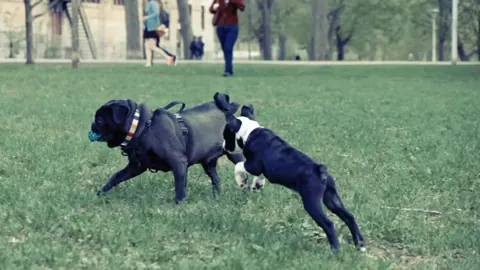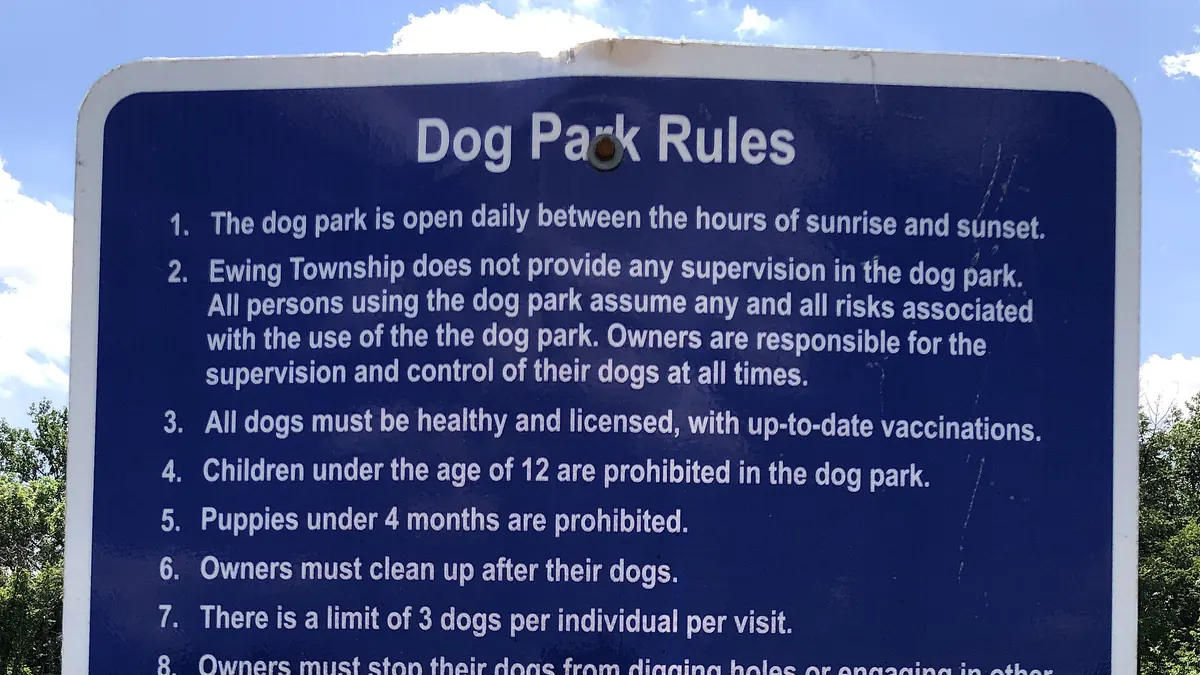
Dog park rules in the US are set city by city, and they differ more than most owners expect. We read the official dog park rules of 20 of the largest US cities and compared them. The short version: Portland and San Francisco have by far the most off-leash places for their size, Los Angeles and Indianapolis the fewest; Houston, Denver, Nashville and Charlotte bar young children outright; Chicago and Indianapolis are the only ones where you pay to use the parks; and Los Angeles and Denver require dogs to be spayed or neutered.
In this guide
- Key findings
- Which cities have the most dog parks for their size?
- The rules, side by side
- Children: the rule that varies most
- How many dogs can you bring?
- Food and treats
- What you pay, and what paperwork you need
- Leash rules outside the dog park
- When dog parks close
- Water, beaches and lakes
- The most unusual rules we found
- What this means if you travel with your dog
- How we compiled this comparison
- Frequently asked questions
Below are the full comparison tables, what each rule means in practice, the oddest rules we found, and how we collected the data.
Key findings
- Access varies 16-fold. Portland has about 5.5 official off-leash places per 100,000 residents; Los Angeles has 0.3.
- Children are the most inconsistent rule. Four cities ban children below a set age, four others allow them only with close adult supervision, and many don't mention children at all.
- Two dogs or three. Where a city caps the number of dogs per person, it's two (Denver, Houston, San José, Nashville) or three (Chicago, Dallas, Atlanta, Portland).
- Food is banned more often than allowed. Six cities ban food; only Denver and Atlanta explicitly allow dog treats, with limits.
- Almost every dog park is free. Chicago charges $10 per dog per year for a required tag; Indianapolis runs a paid pass system, $75 a year or $5 a day.
- Closures catch visitors out. Weekly maintenance days (Dallas, Fort Worth), school-day closures (Portland), rain closures (Dallas, Fort Worth) and heat bans on trails (Phoenix) all appear in official rules.
Which cities have the most dog parks for their size?
We counted the official off-leash locations each city lists — fenced dog parks, open off-leash areas and, in New York, lawns with off-leash hours — and divided by the Census Bureau's 2024 population estimate.
| # | City | Official off-leash locations | Per 100,000 residents | Residents per location |
|---|---|---|---|---|
| 1 | Portland | 35 | 5.5 | 18,000 |
| 2 | San Francisco | 34 | 4.1 | 24,000 |
| 3 | Denver | 17 | 2.3 | 43,000 |
| 4 | Seattle | 16 | 2.0 | 49,000 |
| 5 | New York City | about 150 | 1.8 | 57,000 |
| 6 | Nashville | 11 | 1.6 | 64,000 |
| 7 | Atlanta | 8 | 1.5 | 65,000 |
| 8 | San Diego | 20 | 1.4 | 70,000 |
| 9 | Chicago | 34 | 1.2 | 80,000 |
| 10 | Austin | 12 | 1.2 | 83,000 |
| 11 | San José | 12 | 1.2 | 83,000 |
| 12 | Boston | 7 | 1.0 | 96,000 |
| 13 | Dallas | 11 | 0.8 | 121,000 |
| 14 | Charlotte (Mecklenburg County) | 10 | 0.8 | 121,000 |
| 15 | Phoenix | 13 | 0.8 | 129,000 |
| 16 | Houston | 15 | 0.6 | 159,000 |
| 17 | Fort Worth | 6 | 0.6 | 168,000 |
| 18 | Philadelphia | 8 | 0.5 | 197,000 |
| 19 | Indianapolis | 4 | 0.4 | 223,000 |
| 20 | Los Angeles | 13 | 0.3 | 298,000 |
Where a city lists several areas inside one park (San Francisco's 38 Dog Play Areas sit in 34 parks; Portland's 36 areas in 35 parks; Nashville's 14 areas at 11 locations), we counted parks, so small-dog and large-dog sides aren't counted twice. Charlotte's dog parks are run by Mecklenburg County, so we used the county's population. Boston's count is its five Dog Recreation Spaces plus Smith Playground and the Boston Common off-leash area. Residents per location are rounded.
Two caveats keep this table honest. First, a count isn't the same as space: San Francisco's parks add up to about 50 acres, while Dallas's single largest, NorthBark, covers roughly 12.7 acres on its own. Second, cities rely on other land to different degrees — Los Angeles and San Francisco owners also use county, state and federal land (San Francisco's coast is mostly the Golden Gate National Recreation Area), and Philadelphia has many community-run dog parks outside the official list.
The rules, side by side
| City | Children | Max dogs per person | Food and treats | Cost and paperwork |
|---|---|---|---|---|
| Atlanta | Under 12 with close supervision | 3 | Bite-size dog treats only | Free; licensed and vaccinated |
| Austin | — | — | — | Free |
| Boston | — | — | — | Free; $15–$30 yearly city license |
| Charlotte | Under 12 not allowed | — | — | Free; rabies, DHLPP and Bordetella |
| Chicago | Under 12 with an adult | 3 | No food or treats | $10/dog/year DFA tag |
| Dallas | Under 12 strongly discouraged | 3 | No food or treats | Free |
| Denver | 10 and under not allowed | 2 | Dog treats OK, no human food | Free; city license; spay/neuter or intact permit |
| Fort Worth | Under 12 with an adult | — | — | Free; city license for residents |
| Houston | 12 and under not allowed | 2 | No food or treats | Free; city registration and rabies tags |
| Indianapolis | — | Discount for 2nd and 3rd dog | — | $75/year or $5/day; shot records |
| Los Angeles | Small children closely supervised | — | No food or treats | Free; license; spay/neuter required |
| Nashville | Under 10 not allowed | 2 | No food | Free |
| New York City | Posted per run | Posted per run | Posted per run | Free; carry license and rabies proof |
| Philadelphia | Posted per run | Posted per run | Posted per run | Free; state dog license |
| Phoenix | Under 12 asked not to come | — | No food | Free |
| Portland | — | 3 | — | Free |
| San Diego | — | — | — | Free; license and vaccinations |
| San Francisco | — | — | — | Free |
| San José | Only with a guardian | 2 | — | Free; proof of license on collar |
| Seattle | — | — | — | Free |
"—" means we didn't find the rule in the city's published dog park rules. It doesn't mean anything goes: individual parks often post their own rules at the gate, and state and city licensing laws apply everywhere.
Children: the rule that varies most
No rule splits cities more clearly. There are three camps:
- Banned below an age: Houston (12 and under), Charlotte (under 12), Denver (10 and under) and Nashville (under 10). If you have young kids, these cities' dog parks are adults-only outings.
- Allowed with an adult or close supervision: Chicago and Fort Worth (under 12 with an adult), Atlanta (under 12 with close supervision), San José (with a guardian) and Los Angeles (small children closely supervised).
- Discouraged: Dallas strongly discourages children under 12, and Phoenix asks them not to come.
The reasoning is the same everywhere: running dogs knock small children over, and a child running or screaming can trigger chasing. Even where kids are allowed, the safest approach is to keep them next to you, outside the main play area, and never let them bring food in.
How many dogs can you bring?
Where there's a cap, it's either two dogs per person (Denver, Houston, San José, Nashville) or three (Chicago, Dallas, Atlanta, Portland). Indianapolis doesn't cap the number in its rules we reviewed but prices it: extra dogs on a Pooch Pass get a discount.
The cap matters most to professional dog walkers and multi-dog households. If you walk dogs for a living, check the local rules before you arrive with a pack — some cities also have separate permit rules for commercial dog walkers in parks.
Food and treats
Six cities ban food inside the dog park: Chicago, Los Angeles, Houston and Dallas ban all food including dog treats, and Nashville and Phoenix ban food. Only two cities spell out an exception: Denver allows dog treats but not human food, and Atlanta allows only bite-size dog treats.
The rule exists because food is one of the most common triggers for scuffles — one owner with a pocket of treats can draw a crowd of dogs, and resource guarding does the rest. Even where treats are allowed, it's wise to use them sparingly and never around a group. See our guide to what to bring to the dog park for what to leave at home.
What you pay, and what paperwork you need
Eighteen of the 20 cities charge nothing to use their dog parks. The two exceptions work very differently:
- Chicago requires a Dog Friendly Area permit and tag for every dog, issued by participating vets for $10 a year. Using a DFA without one can bring a $500 fine.
- Indianapolis runs its four Bark Parks on passes: $75 a year for the first dog, $5 per dog per day, or $125 for a VIP pass that opens all four parks. You buy it in person, with shot records.
Beyond fees, paperwork is where the real differences are:
- Spay/neuter requirements: Los Angeles requires dogs to be spayed or neutered under city law. Denver requires it too, unless the dog has a Denver intact permit.
- Extra vaccines: most cities ask for rabies only. Charlotte (Mecklenburg County) also requires DHLPP and Bordetella; Indianapolis asks for rabies, parvo, distemper and Bordetella when you buy a pass.
- Tags you must display: Houston wants both city registration and rabies tags on the collar; San José wants proof of license worn by the dog; New York requires owners to carry proof of license and rabies vaccination in public.
Leash rules outside the dog park
Every city in our list requires leashes in regular parks outside designated areas. Some also set a maximum length:
| Maximum leash length | Cities |
|---|---|
| 6 feet | New York City, Philadelphia |
| 8 feet | San Diego, Boston |
A retractable leash let out past those lengths doesn't comply. Enforcement also varies: Atlanta's "Leash Up ATL" campaign has police citing owners with dogs off leash, Seattle Animal Control officers enforce animal laws seven days a week, and Chicago's $500 fine for using a DFA without a tag is one of the steepest penalties we found.
When dog parks close
Hours are where visitors get caught out most often:
- Weekly maintenance days. Dallas's big parks close one weekday each (NorthBark on Tuesdays); in Fort Worth, ZBonz closes Wednesdays and Fort Woof Thursdays.
- Rain closures. Dallas runs a Rain Out Line (214-614-6711), and Fort Worth's large parks can close when the ground is saturated.
- School days. Seven of Portland's off-leash areas close from 8 a.m. to 4 p.m. on school days.
- Off-leash hours. New York's open-lawn off-leash areas are legal only before 9 a.m. and after 9 p.m. — at 9:01 a.m. the same lawn is leash-only.
- Heat. Phoenix bans dogs from city hiking trails on days of 100°F or hotter.
- Late nights. A few parks stay open late for after-work visits: many Phoenix dog parks until 11 p.m., Denver's Railyard Dog Park until 11 p.m., and two downtown Nashville parks until 11 p.m.
Water, beaches and lakes
Water access is rare and heavily regulated:
- San Diego is the standout: Dog Beach in Ocean Beach is off-leash and open 24 hours, and Fiesta Island is leash-optional across the island. Most of Mission Bay, though, bans dogs during daytime hours for much of the year.
- Seattle never allows dogs on park beaches, leashed or not. Magnuson Park is the only off-leash area in the city with water access.
- Austin's lakefront favorites, Red Bud Isle and Auditorium Shores, come with a city advisory to keep dogs out of Lady Bird Lake because of toxic algae. The city attributes six dog deaths since 2019 to algae toxins there.
- New York allows dogs on beaches only in the off-season, from October 2 through the Friday before Memorial Day.
More in our guide to dog beach rules and safety.
The most unusual rules we found
- Nashville bans organized activities — no training classes, adoptions or events inside the dog parks.
- Atlanta bans strollers, bicycles, skateboards and rollerblades in off-leash areas, and bans pets from Piedmont Park entirely during major festivals.
- Fort Worth defines "small dog" by weight: its small-dog areas are for dogs under 40 pounds. Most cities leave it to the owner.
- Fort Worth says don't hang your leash on the fence — keep it on you.
- Portland's Gabriel Park moves its off-leash area between a summer site and a winter site.
- Boston Common rotates its off-leash parcel, so owners check a map before going.
- Dallas, Atlanta and Nashville ban prong or spiked collars inside dog parks.
What this means if you travel with your dog
If you visit several of these cities, a few habits cover almost every rule:
- Carry a 6-foot leash — it meets the strictest length limit on the list.
- Keep your dog's license and rabies tags on the collar, and a photo of vaccination records on your phone.
- Leave food and treats in the car unless you've checked the city allows them.
- Bring no more than two dogs per adult.
- Leave young children with another adult if you're heading to a Houston, Denver, Nashville or Charlotte dog park.
- Check the day and the weather before driving to a big Texas dog park.
- In Chicago and Indianapolis, sort out the tag or pass first — you can't buy them at the gate.
How we compiled this comparison
We read each city's official dog park rules and park listings — published by the city's parks department or city code (Mecklenburg County for Charlotte) — as they appeared in 2026. Where a city's own website blocked automated access, we used archived copies of the official pages or the city's own open-data and map services. Population figures are the US Census Bureau's Vintage 2024 estimates for each city (for Nashville and Indianapolis, the consolidated city's "balance"; for Charlotte, Mecklenburg County).
We didn't count county, state or federal land, or private and community dog parks. We didn't visit the parks — this is a comparison of published rules, and posted signs at individual parks can add to them. If you spot a rule that has changed, the city's parks department is the final word.
Frequently asked questions
Which US city has the most dog parks per person?
Among the 20 large cities we compared, Portland, Oregon: about 5.5 official off-leash places per 100,000 residents, followed by San Francisco at 4.1.
Which big city has the fewest dog parks for its size?
Los Angeles, with 13 city dog parks for about 3.9 million residents — roughly one for every 300,000 people. Indianapolis and Philadelphia are next.
Are dog parks free in the US?
Almost always. Of the 20 cities we compared, only Chicago ($10 per dog per year for a required tag) and Indianapolis ($75 a year or $5 a day) charge to use city dog parks.
Can kids go to dog parks?
It depends on the city. Houston, Charlotte, Denver and Nashville don't allow children below a set age (from under 10 to 12 and under). Many others allow them with close adult supervision.
How many dogs can one person bring to a dog park?
Where a limit exists, it's two dogs per person (Denver, Houston, San José, Nashville) or three (Chicago, Dallas, Atlanta, Portland).
Can I bring treats to a dog park?
Often not. Chicago, Los Angeles, Houston and Dallas ban all food including treats. Denver allows dog treats and Atlanta allows bite-size dog treats only.
Sources: official dog park rules and listings of the cities of Atlanta, Austin, Boston, Chicago (Chicago Park District), Dallas, Denver, Fort Worth, Houston, Indianapolis (Indy Parks), Los Angeles, Nashville (Metro Parks), New York (NYC Parks), Philadelphia, Phoenix, Portland, San Diego, San Francisco, San José and Seattle, and Mecklenburg County Park and Recreation, as published in 2026; US Census Bureau, Vintage 2024 population estimates.